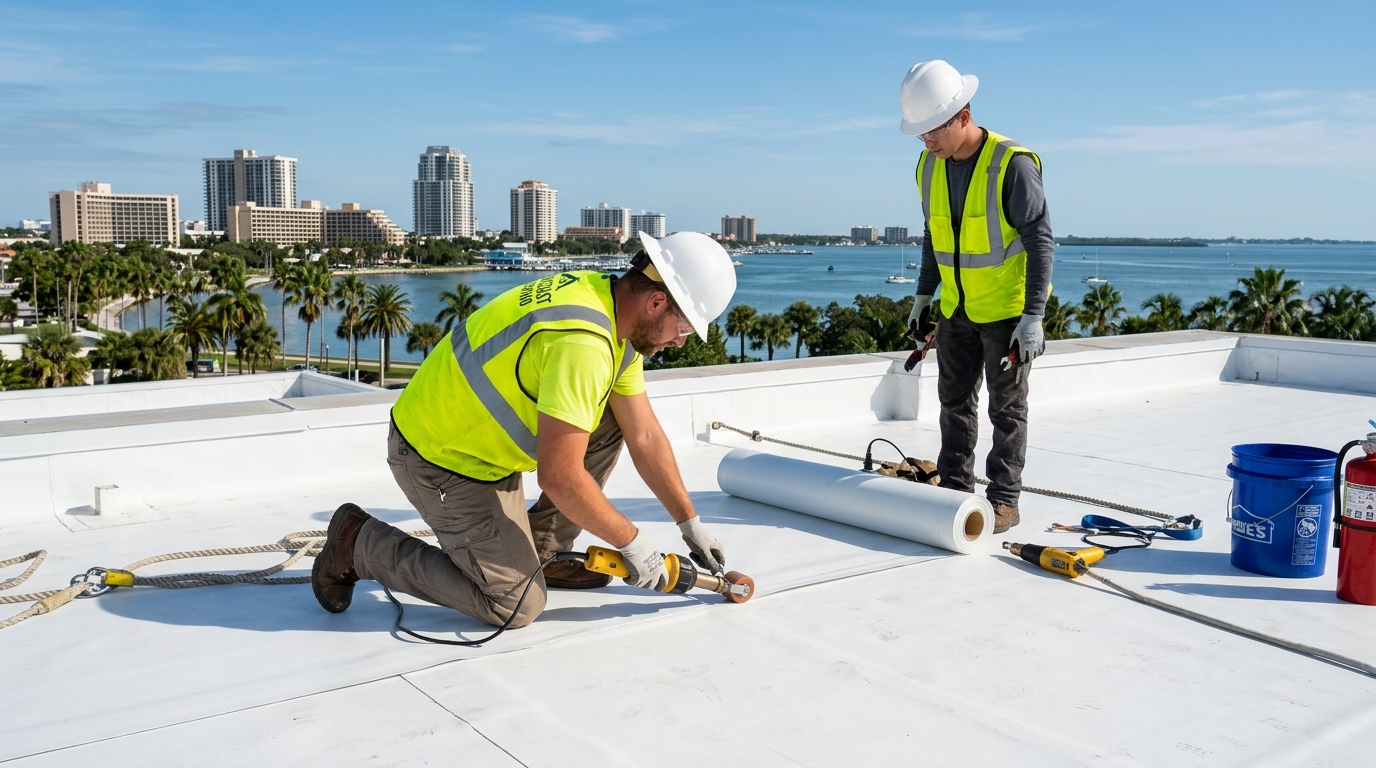
High-Wind Shingle Re-Bonding & Course Reconstruction
CSRA thunderstorm downdrafts funnel extreme wind shear across exposed roof slopes, breaking thermal sealant strips and tearing away architectural shingle tabs.
Dispatched roofing specialists hand-tab lifted shingles using commercial SBS elastomeric adhesive, replace missing shingles, and install 6-nail fastening patterns.
Key Technical Engineering Protocols:
- ✓ Hand-sealing unbonded tabs with high-grade elastomeric polymer cement.
- ✓ Replacement of torn shingle courses meeting Georgia DCA wind codes.
- ✓ Perimeter rake and eave edge reinforcement preventing peel back.
Property owners across Augusta, Richmond County, Columbia County, and Aiken County facing active roof leaks, missing shingles, or catastrophic tree falls can rely on our 24/7 emergency dispatch network. Call our central intake desk now at (888) 208-4155. We match you with verified, licensed local roofing contractors ready for immediate deployment.
1. CSRA Wind Storm Dynamics & Savannah River Pine Fall Exposure
Augusta and the surrounding Central Savannah River Area (CSRA) occupy a distinct meteorological transition between the Georgia Piedmont fall line and the Atlantic coastal plain. This geographic positioning subjects Richmond and Columbia counties, as well as Aiken County in South Carolina, to intense convective thunderstorm squall lines, severe summer downbursts, and tropical storm remnants tracking inland along the Savannah River basin. Straight-line wind gusts regularly exceed 60 to 75 mph, creating extreme aerodynamic uplift along exposed roof rakes, eaves, and ridgelines.
The signature roofing hazard across the CSRA stems from massive mature loblolly and longleaf pines. In Augusta neighborhoods like Summerville, Forest Hills, and West Augusta, as well as suburban communities in Evans, Martinez, and Grovetown, tall pine trees grow in sandy loam and red clay soils. Prolonged soaking rains saturate root systems, and sudden thunderstorm wind shear snaps heavy branches or topples 70-foot pines directly onto residential roof envelopes, punching through structural decking and crushing rafter chords.
- Severe Convective Wind Shear: High-velocity downdrafts breaking thermal shingle sealant strips and lifting entire shingle courses.
- Mature Pine Tree Impact: Punctured OSB/plywood decking, cracked trusses, and broken load-bearing framing.
- Heavy Tropical Rain Bands: Driving rain overwhelming eave flashings, valley troughs, and clogged gutter lines.
- Gutter Drip Edge Fascia Rot: Heavy pine needle accumulation trapping acidic moisture along eave drip edges, decaying wood fascias.
2. Non-Destructive Moisture Diagnostics & FLIR Thermal Tracing
Locating an active leak in an Augusta residence requires forensic diagnostic tools. Rainwater entering through an exterior breach rarely falls straight down onto the ceiling below. In homes with complex multi-pitch roofs, vaulted ceilings, or spray-foam attic insulation, intruding water travels along sloping rafter tops, electrical wiring conduits, and HVAC ductwork before dripping through drywall seams dozens of feet away. Patching only where the interior ceiling stain appears leaves the exterior puncture untreated, causing hidden wood rot and mold growth.
Dispatched emergency contractors employ high-resolution FLIR (Forward-Looking Infrared) radiometric thermal imaging cameras combined with non-destructive dielectric moisture meters. Wet cellulose insulation and damp framing retain cold thermal footprints compared to dry surrounding structures. Thermal scans clearly reveal the complete concealed moisture migration corridor without damaging sound interior finishes.
- FLIR Thermal Thermography: Identifies hidden sub-surface moisture pockets in attic framing and ceiling assemblies.
- Dielectric Impedance Scanning: Measures moisture content percentages inside roof decking without puncturing membranes.
- Fiber-Optic Cavity Inspection: Assesses tight soffit returns, cathedral ceiling cavities, and chase walls.
- Adjuster-Compliant Photo Dossiers: Generates timestamped visual proof supporting Georgia and South Carolina insurance claims.
3. Step-by-Step Substrate Restoration & Engineered Tarping Methodology
Emergency roof mitigation requires disciplined structural methodology to halt water ingress without inducing further damage to sound roofing components. Flimsy blue plastic tarps weighed down with bricks or secured with surface staples are torn away by the first 25 mph wind gust, causing catastrophic interior flooding. Dispatched CSRA crews deploy engineered timber-batten tarping or commercial heat-activated shrink-wrap containment designed to withstand gale-force winds.
Technicians first clear fallen tree branches using controlled rigging, then inspect the structural deck. Decking punctures are patched with 5/8-inch CDX exterior plywood screwed into rafters. Heavy-duty 12-mil cross-laminated poly tarps are stretched taut across breaches, wrapping over the ridge to eliminate top water entry, and anchored with kiln-dried 2x2 spruce-pine-fir battens mechanically fastened into rafters. For complex multi-pitch architectural roofs, thermal shrink-wrap membranes are heat-formed into a seamless, drum-tight protective barrier.
- Timber-Batten Rafter Anchoring: Kiln-dried 2x2 lumber fastened with 3-inch exterior screws (strictly zero surface staples).
- Commercial 12-Mil UV Poly: High-tensile, tear-resistant woven membranes rated for extended storm cycles.
- Emergency Thermal Shrink-Wrap: Heat-welded 9-mil virgin polymer wrapping complex hips, valleys, and dormers seamlessly.
- Structural Plywood Deck Gussets: 5/8-inch CDX plywood plates reinforcing fractured rafters and covering deck punctures.
4. Georgia (DCA) & South Carolina (LLR) Building Codes & Licensing Compliance
Operating across the CSRA requires strict adherence to dual-state regulatory standards. On the Georgia side of the Savannah River (Augusta, Evans, Martinez, Grovetown, Hephzibah, Harlem), roofing replacements and structural repairs must comply with the Georgia State Minimum Standard Building Code (International Residential Code Chapter 9 with Georgia Department of Community Affairs amendments). Contractors must hold residential or general contracting licenses issued by the Georgia State Licensing Board for Residential and General Contractors (RCL/GCL).
Across the river in North Augusta and Aiken County, South Carolina, work is governed by the South Carolina Residential Builders Commission (SC Department of Labor, Licensing and Regulation - LLR). Both jurisdictions strictly enforce high-wind fastening requirements: architectural shingles must be fastened using code-mandated 6-nail patterns in high-wind zones, approved corrosion-resistant drip edge flashings must be installed along eaves and rakes, and self-adhering polymer-modified bitumen ice-and-water underlayment must be applied in all valleys and low-pitch roof transitions.
- GA DCA Code Chapter 9 & SC LLR: Full compliance with state minimum residential codes.
- Enhanced 6-Nail High-Wind Pattern: 110-130 mph wind uplift rating preventing shingle blow-off along rakes and eaves.
- Code-Mandated Metal Drip Edge: Corrosion-resistant metal flashing along eaves and rakes preventing fascia rot.
- Independent Licensing & Insurance: Referred contractors maintain verified state credentials, workers comp, and general liability.
5. Preventative Property Maintenance & CSRA Storm Preparedness
Proactive roof maintenance is essential in the heavily forested CSRA. Homeowners can prevent catastrophic storm damage by systematically trimming overhanging pine branches, clearing gutter lines, and addressing minor flashing flaws before severe convective squalls strike. Keeping tree limbs pruned at least 10 feet away from the roofline significantly reduces direct branch puncture risks during high-wind events.
Additionally, regular clearance of pine needles from roof valleys and gutter drip edges prevents the buildup of acidic debris dams that rot underlying wood fascias and backup water under shingle courses. Semi-annual inspections verify that pipe boots, chimney flashings, and shingle seal strips remain completely watertight, protecting valuable properties through the severe CSRA weather season.
- Overhang Arborist Clearance: Prune pine and oak branches to maintain a minimum 10-foot buffer from roof surfaces.
- Pine Needle Valley Clearing: Remove trapped acidic organic matter from valleys and chimney crickets every autumn and spring.
- Gutter & Drip Edge Inspection: Verify seamless gutter flow and inspect eave wood fascias for early rot signs.
- Post-Storm Visual Checks: Look from ground level for lifted tabs, missing ridge caps, or fallen branches after wind events.
Need Immediate Augusta Shingle Blow-Off Patch in Augusta?
CSRA wind gusts, fallen loblolly pine limbs, and severe shingle blow-offs demand rapid emergency mitigation before rainwater destroys ceiling drywall, structural framing, and home electrical systems. Dispatched independent contractors arrive equipped with heavy commercial timber battens, thermal shrink-wrap membranes, and FLIR diagnostic tools.